
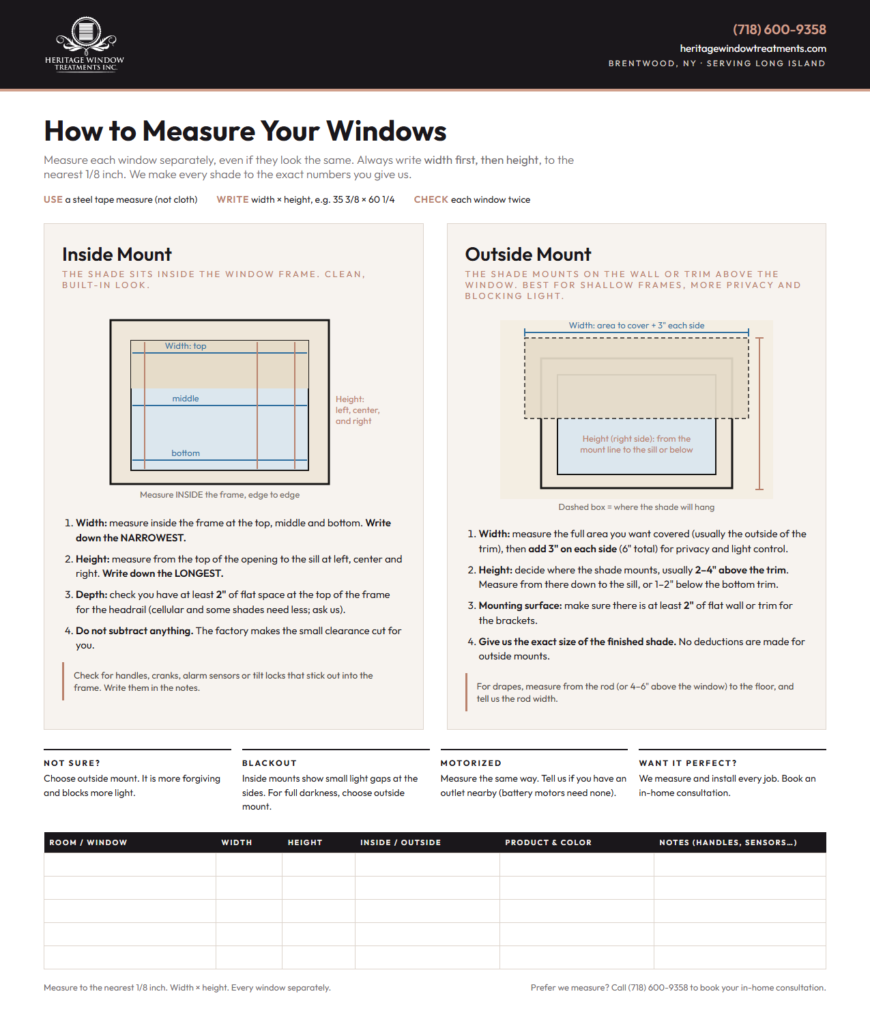
Measuring your windows is the first step to a clear price and a perfect fit. Whether you are planning a budget, comparing styles or getting ready for your consultation, this guide walks you through it step by step, the same way we measure on every Heritage job across Long Island.
Good to know: your measurements help you plan and get a realistic estimate. Before anything is ordered, Heritage measures every window in person, so the final fit is on us.
What you need
- A steel tape measure. Cloth and sewing tapes stretch and give the wrong number.
- A pencil and paper, or our free printable worksheet below.
- A step stool for tall windows.
- About 2 to 3 minutes per window.
The three rules that prevent almost every mistake
- Width first, then height. Always write it as width × height, for example 35 3/8 × 60 1/4. Mixing them up is the most common ordering mistake.
- Measure to the nearest 1/8 inch. Round nothing up or down.
- Measure every window separately, even windows that look identical. Older Long Island homes often have windows that differ by 1/4 inch or more.
Inside mount or outside mount?
Decide this first, because you measure differently for each.
- Inside mount: the shade or blind sits inside the window frame. It gives a clean, built-in look and shows off your trim. You need enough depth in the frame, usually at least 2 inches of flat space at the top.
- Outside mount: the shade mounts on the wall or trim above the window and covers the whole opening. It is the better choice for shallow frames, for blocking the most light in bedrooms, for making a window look bigger, and for windows with handles or cranks that stick out.
Not sure? Outside mount is more forgiving and blocks more light. For full darkness in a bedroom, choose outside mount, since inside mounts always leave a small light gap at the sides.
How to measure for an inside mount
- Width: measure inside the frame, edge to edge, at the top, middle and bottom. Write down the narrowest of the three.
- Height: measure from the top of the opening down to the sill at the left, center and right. Write down the longest of the three.
- Depth: check that you have at least 2 inches of flat surface at the top of the frame for the headrail. Some shades, like cellular shades, need less.
- Write the exact numbers. Leave the clearance deductions to us. The factory makes the small clearance cut so the shade fits and operates smoothly.
Watch for: window handles, cranks, alarm sensors and tilt locks that stick out into the frame. Write them in your notes, because they can change the right product or mount.
How to measure for an outside mount
- Width: measure the full area you want covered, usually the outside edges of the trim, then add 3 inches on each side (6 inches total) for privacy and light control.
- Height: decide where the shade will mount, usually 2 to 4 inches above the trim. Measure from that line down to the sill, or 1 to 2 inches below the bottom of the trim if there is no sill.
- Mounting surface: make sure there are at least 2 inches of flat wall or trim for the brackets.
- Write the finished size you want the shade to be. Outside mounts are made exactly to the size you give.
How to measure for drapery
Drapery is measured from the rod, so plan the rod first.
- Rod height: mount the rod 4 to 6 inches above the window, or about halfway between the window and the ceiling. Hanging it higher makes ceilings look taller.
- Rod width: extend the rod 8 to 12 inches past each side of the window so the open drapes stack on the wall and the full glass stays clear.
- Length: measure from the rod (or from where the rings will hang) down to the floor, then choose your style:
- Kiss the floor: about 1/2 inch above the floor. Clean and tailored, and the most popular look.
- Break: 1 to 2 inches extra, so the fabric rests softly on the floor.
- Puddle: 4 to 6 inches extra for a relaxed, formal look. Best in rooms with little foot traffic.
- Fullness: for a rich, full look, the total fabric width is usually 2 to 2 1/2 times the rod width. We calculate this for you; just give us the rod width.
Special windows
- Sliding glass doors: measure for an outside mount, and add extra width on the side where the door opens so the treatment stacks clear of the door. Vertical blinds, panel tracks and drapery are the usual choices.
- Bay and bow windows: measure each window in the bay separately as an inside mount. Note the angles of the corners; we account for them so the shades sit neatly side by side.
- French doors: measure the glass area plus the frame, and check the depth of the door frame for clearance from the handle.
- Arched and specialty shapes: measure the width at the base and the height at the tallest point, then take a photo. Shapes like these are best measured in person.
- Motorized shades: measure the same way, and note whether there is an outlet nearby. Battery and rechargeable motors need no outlet.
Common measuring mistakes
- Writing height first, or not labeling which number is which.
- Measuring only one spot instead of the top, middle and bottom.
- Rounding to the nearest half inch.
- Assuming identical-looking windows are the same size.
- Forgetting the handle, crank or alarm sensor in the frame.
- Subtracting for clearance on an inside mount. We do that for you.
Free printable measuring worksheet
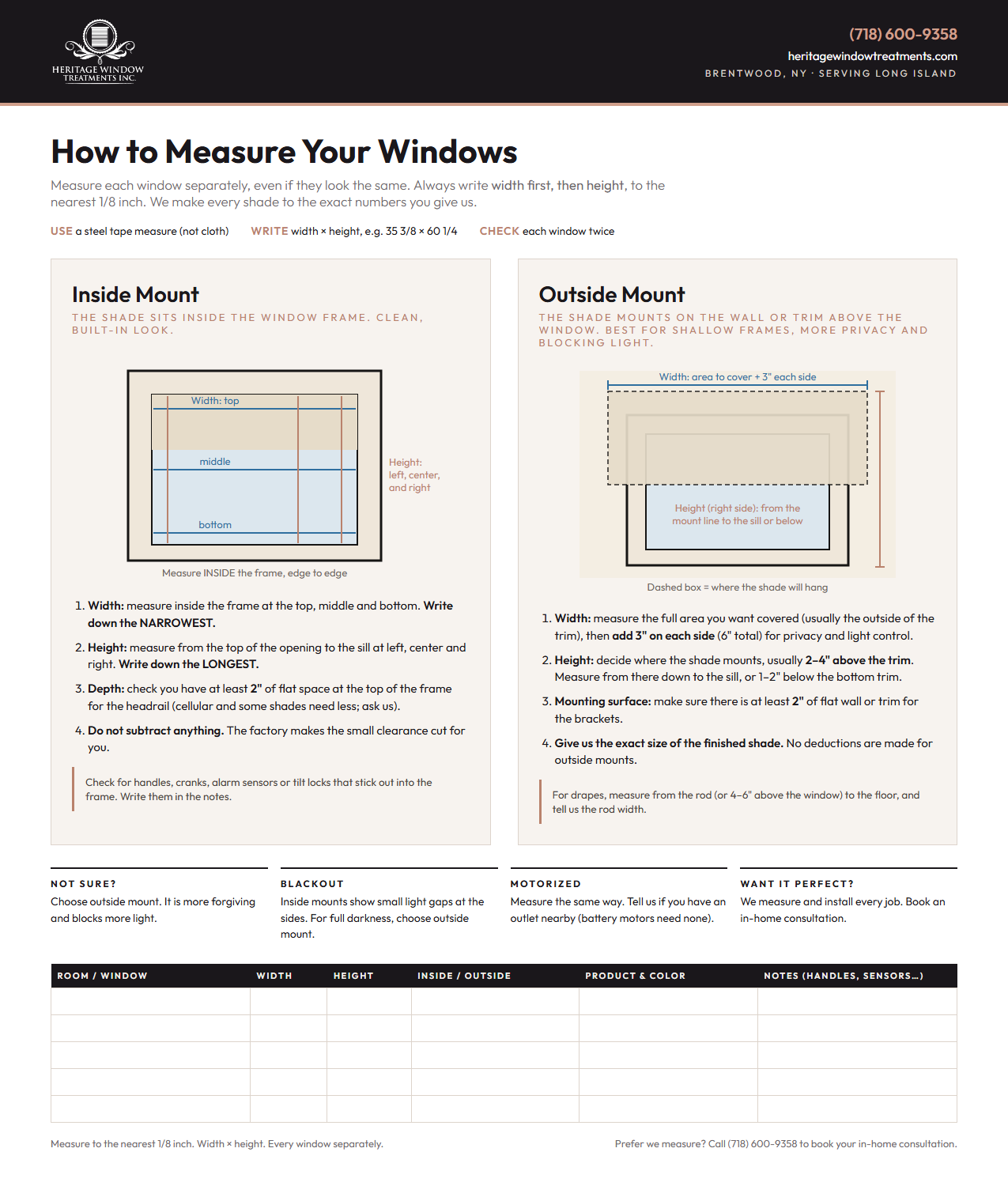
Print this sheet, walk through each room and fill in the table at the bottom. Bring it to your consultation or send us a photo of it.
Prefer we measure for you?
Every Heritage project includes professional measuring. At your in-home design consultation we measure each window, check depth and clearances, bring samples you can see in your own light, and recommend the right mount for every room. Your treatments are made to our measurements and installed by the same team.
Book your in-home design consultation or call (718) 600-9358. See our guides to custom blind costs, custom drape costs and plantation shutter costs on Long Island.
Frequently asked questions
Should I measure the window or the old blind?
Measure the window. Old blinds may have been made the wrong size, and replacing them with the same size repeats the mistake.
Do I subtract anything for an inside mount?
No. Give the exact inside measurements. The clearance deduction is made at the factory so every shade fits and operates smoothly.
How much depth do I need for an inside mount?
Most blinds and shades need about 2 inches of flat surface at the top of the frame. Some cellular shades need as little as 1 inch, while wood blinds and some motorized shades need more. If your frame is shallow, an outside mount is a great option.
What if my windows are not square?
That is common in older homes. Measuring at three points for both width and height catches it. Use the narrowest width and the longest height for an inside mount, or choose an outside mount to hide the difference.